Here’s a great tip for smoking or roasting small pieces of vegetables or any other small things. Get some steel string from your local hardware store, and just string them up, like so. This worked great when smoking a bunch of chillies for my homemade ketchup.
Tag Archives: easy
Whole, smokegrilled trout
There’s nothing that spells summer to me like grilling a whole salmon or trout. Grilling it whole also makes it juicier and more forgiving in terms of temperature. One small note on this, I see a lot of people “grilling” whole fish completely wrapped in aluminium foil. Now I don’t mean to be a BBQ snob, but I am, so here goes. When you do that, you’re basically steaming the fish, not grilling it. There’s also no way for smoke and other flavours of the grill to get into the fish. So, you might as well go inside and steam it in your kitchen, much easier. There.
Now that’s out of the way, let’s look at a good way of getting that delicious smokegrilled flavour on a big piece of whole fish. Trout or salmon can be used here, that’s up to you.
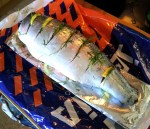
- Prepping the trout. Lemon and dill.
- Whole smokegrilled trout on the grill. Note homemade cardboard plank to ease moving.
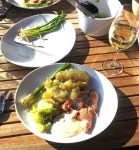
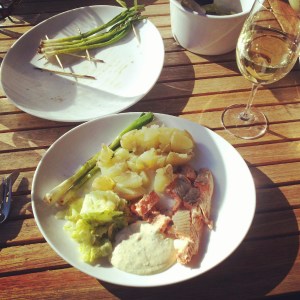
- Whole smokegrilled trout, butter-steamed spring cabbage, scallions, new potatoes and mustard-dill sauce
Total time: 2-3 hours
Skill level: Easy/intermediate
Grilling method: Indirect, two-zoned (some coals on each side, none in the middle)
Grill temperature: About 175 degrees centigrade (350F)
You’re going to need:
A medium-large whole trout (or salmon)
2 lemons
Some butter
Fresh dill
A clove of garlic
Salt and pepper
Oak wood chips (alternatively alder or fruit wood)
(Optional) A long fish basket for large fish
If no fish basket, some cardboard and heavy-duty aluminium foil
Serving suggestions:
Mustard-dill sauce
New potatoes (boiled or baked on the grill)
Butter-steamed spring cabbage
Grilled spring onions
How you do it:
- Get the grill started as instructed above
- Clean the fish if it hasn’t been done for you. Remove the head, tail, use kitchen shears to cut off any fins. Rinse it off in ice-cold water and dry with paper towels
- Cut some diagonal slashes on both side of the fish, quite deep. We do this to allow the smoke and flavours to penetrate the meat properly when grilling.
- Put thinly sliced lemon and some dill sprigs in each slash
- Season the inside of the fish with salt and pepper, put some more lemon slices and dill sprigs in there too
- Make a herb butter by melting a cup of butter, then chucking in a minced garlic clove and a handful or two of chopped dill. I also put some pepper in there, but that’s optional
- If you have a fish basket, good. If not,cut out two pieces of cardboard slightly larger than your fish. Wrap them in two layers of heavy-duty aluminium foil
- Brush one of your new cardboard “planks” with butter
- Brush the fish on both sides with herb butter and put it in your fish basket or on your cardboard plank
- Put some water-soaked smoke wood chips on the coals. I like to get a good smoke level started before I put on meat or fish, because raw meat seems to take up smoke flavour more readily. This goes for all meats. Always get the smoke going good first, then put the food in.
- Once the smoke gets going, put the fish in the middle of the grill, on its plank/basket
- Baste the fish with herb butter every ten minutes
- When the fish has been on the grill for 30-40 minutes, depending on size and temperature, it’s time to flip it. If you have a fish basket, that’s easy. If you have cardboard planks, butter up the second plank, and use your grilling gloves to flip the fish over on plank #2. It can be a bit tricky, so be careful
- Grill the fish another 30-40 minutes until ready. If you have a Thermapen or other instant-read thermometer, look for the fish to be 55 degrees centigrade (about 130F). If you don’t have an instant read thermometer, make a small incision on the widest section of the fish near the backbone. The meat should be pale pink and opaque, not translucent and pink/orange.
- Serve!
Simple mustard-dill sauce
Here in Scandinavia, trout and salmon is very often served with dill and mustard. So why not make a sauce of it? This goes well with any salmon or trout dish.
Time: 10 minutes
Skill level: Easy
You’re going to need:
1.5 cups of mayo (homemade is best of course!)
0.75 cup sour cream
0.5 cup of dijon mustard, honey mustard or sweet Swedish mustard, depending on what your preference is
Handful of chopped fresh dill
Some lemon juice
Salt and pepper
How you do it:
- Put everything except lemon juice and salt and pepper in a bowl and whisk it all together
- Season with lemon juice, salt and pepper
- Serve!
Did I mention this sauce goes well with for instance smokegrilled trout
Butter-steamed spring cabbage
Spring cabbage is one of the tastiest vegetables out there. It goes well with grilled fish, especially salmon or trout. In Norway we call it summer cabbage, because that’s when you can get it here. This is the easiest and best way to prepare it if you ask me, and it’s super fast.
Time: 10 minutes
Skill level: Easy
Grilling method: Steaming over direct heat
Grill temperature: Doesn’t really matter
You’re going to need:
A head of spring cabbage
4 tablespoons of butter
Salt and pepper
Aluminium foil
How you do it:
- Slice the cabbage in longish strips about a half-inch wide
- Make a big sheet of aluminium foil, put 4 tablespoons of butter on it
- Put the cabbage on top of the butter
- Season with salt and pepper
- Make it into a bowl shape, that you half close on top
- Put it over direct heat on the grill, and let the butter steam the cabbage for about 5-10 minutes depending on heat level
- Serve!
This goes well with for instance a whole grilled trout or smokegrilled mackerel
Which smoke wood to use when?
I get a lot of questions on which smoke wood to use for which foods. Here are some suggestions. Like anything else to do with BBQ, this is no exact science. And remember, what kind of rub or sauce you use and the spice level should also be part of the consideration.
Pork – Pork works well with lots of different smoke woods. I like to use almost anything for pork. I use mesquite a lot for pork, and I use apple (real good for ribs), cherry and pecan wood. Sometimes when I really want smoke taste on pork butts, I use hickory as well. Want something light? Try Alder.
Beef – Beef=hickory in my mind. Sometimes I’ll mix 50/50 hickory and mesquite. Oak is also good, the Jack Daniel’s oak wood chips are great for steaks for instance.
Poultry – For poultry I would normally pick something lighter, like cherry or apple. Sometimes I use mesquite, it can be real tasty with duck, which has a stronger, more gamey taste than chickens
Fish – Oak or alder is very popular for smoking fish. Here in Norway the juniper bush is sometimes used, but I find the taste too owerpowering.
Vegetables – Since they’re not the stars of the show, my vegetables usually get smoked with whatever I’m using for the meat. Hickory and mesquite is great for baked potatoes and ears of corn (prick the potatoes with a fork first).
Lastly, experiment. A lot. It’s the only way to learn what’s best for your tastes. There’s also other ways to make smoke, rosemary smoke from fresh rosemary for lamb for instance. Vines of various kinds can also be used. But don’t use fresh wood, it needs to be dried. Nothing green should go on the grill as smoke wood.
Smokegrilled mackerel
Mackerel is one of my favorite fish to eat. It brings back memories of summers spent fishing in my little dingy outside Bergen on the west coast of Norway. A feisty fish that was fun to fish for as a kid growing up. It’s nice and juicy thanks to very high-fat content, and that also makes it very healthy, full of omega-3 and other good stuff. I think mackerel tastes fantastic, and I like to keep it really simple. Salt and pepper for seasoning, new potatoes on the side, with a sour cream sauce and some good butter. One thing that makes mackerel perfect for the grill, is the fact that it can smell quite strong. Fun when you’re making it and eating it, not so fun three days later in your kitchen. So, let’s take the mackerel outside!
In this recipe I combine smoking with high temperature grilling. Mackerel being a fatty fish, it takes up smoke flavour quite readily, so you don’t need a lot of time to get the right amount of smoke flavour into the meat.
Time: 45 minutes total
Skill level: Easy
Grilling method: Direct
Grill temperature: About 200-250 degrees centigrade (390-480F)
Equipment: Fish basket, cherry wood chips for smoke
You’ll need to get hold of:
Fresh, raw mackerel (1 large per person)
New potatoes
Butter
Sour cream
Lemon
Fresh Dill
How you do it:
- Have a hot grill waiting, with the 50/50 setup (coals on one side)
- If you’re baking the new potatoes, prick them with a fork all around so smoke can get in, throw some wood chips on the coals and leave these on the indirect side of the grill. They will need 45-60 minutes depending on size
- Prep and clean the mackerel unless you had the fish shop do it for you, remove all guts and blood, rinse and dry off with paper towels. I like to leave the tails and heads on, but you can remove these if you’re wimpy about it or if your kids have watched Finding Nemo too many times…
- Liberally season the fish inside and outside with Maldon salt and freshly ground black pepper (I use Tellicherry)
- Put the mackerel in your fish basket (oil it if it’s not a non-stick one). A fish basket is really necessary here, because mackerel will stick to your grill grate like crazy and it will be extremely difficult to flip the fish without it falling apart
- Make a very simple sour cream sauce. I mix sour cream with some lemon juice, salt and pepper, and some freshly chopped dill
- Grill the mackerel over direct heat, until the skin is nicely crispy and the meat falls of the bone easily (use a fork to test). If you’re using a thermometer, mackerel is a cold water fish and as such it should be ready when the meat is about 55 degrees centigrade (131F), but it’s so fatty it will stay nice and juicy way above that temperature too.
- Serve with the baked new potatoes, sour cream sauce and some butter for those who want it. Easy living!
Basic homemade lemonade
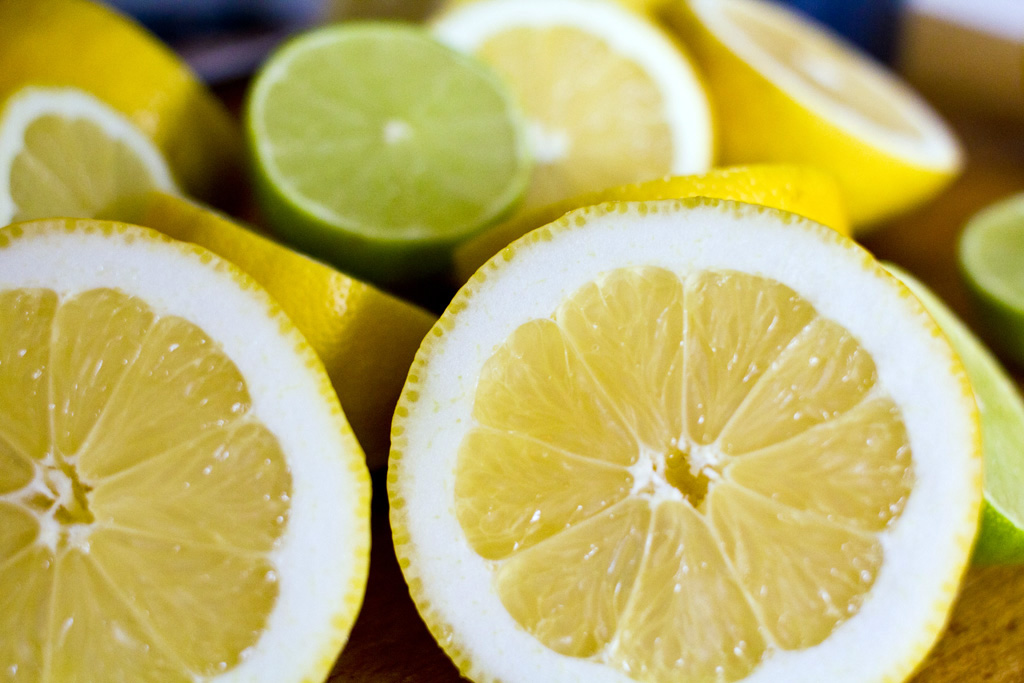
Homemade lemonade is a treat. When it gets really hot (not so often here in Oslo, but it happens), nothing beats a glass of ice cold lemonade (well maybe ice tea). I promise you it’s more healthy than sodas and other readymade drinks which are always full of cheap sweeteners like corn syrup and other nasty stuff… Here’s how how I do it, this recipe makes for about 3 liters (a little less than 6 pints).Time: 10-15 minutes
Skill level: Easy
You’ll need to get hold of:
12 lemons
4 limes
3 cups of sugar
Water
Lots of ice cubes
How you do it:
- Put 3 cups of granulated white sugar and 6 cups of water in a pot
- Make it boil (I trust you know how)
- While you wait for the boil, squeeze 6 lemons and 2 limes into each of your lemonade pitchers. Put a small pinch of salt in each one to increase flavour
- Turn off your stove and stir until all sugar is dissolved
- Fill your pitchers 2/3 full with ice cubes
- Divide the simple syrup (sugar+water)in the two pitchers, and pour it on so most of the ice melts and the syrup gets cooled instantly
- Put in more ice if needed, you can also add more ice cold water if the lemonade’s too strong
Butterflied Chicken
Whole chickens are one of my favorite things to grill. They’re tasty, juicy, and here in Norway, cheap. A lot of people grill chicken breasts only, which I think is REAL boring. They don’t taste much unless you do a lot to them, and they dry out easily unless you brine them and do other secret tricks. A whole chicken is much more forgiving in terms of temperature, and much tastier too. Also, I am a leg man (I prefer the thighs with their juicy, darker meat). This recipe makes use of the butterflying technique which essentially lets you flatten the whole bird, making it easier to cook it evenly and shortening cooking time for those weeknight BBQs. I get my chicken thighs and legs, and there’s two nice chicken breasts for my wife and the kids. Everybody wins with whole chicken!
Skill level: Easy
Grilling method: Direct/indirect
Grill temperature: About 200-250 degrees centigrade (390-480F)
Equipment: Fish basket (optional), mesquite wood chips or chunks for smoke
You’ll need to get hold of:
A whole, raw chicken
Your favorite home-made BBQ rub (or a store-bought one)
Some hot chili sauce
How you do it:
- Have a hot grill waiting (don’t you always?)
- Prep the chicken; trim off unneccesary fat, cut out the backbone and remove wishbone (Great TVWB instruction video here). Finally rinse under cold water and dry with paper towels. I tend to use disposable vinyl gloves for this whole process. Always take extra care with hygiene and cleanliness when working with raw poultry!
- Make yourself a simple wet rub/sauce mixture. I mix up my home-made rub-a-dub with some rapeseed oil and some hot asian chili sauce I buy from the local Turkish convenience store. Use what you have access to, but the goal is to end up with a nice sticky sauce that can be brushed on the chicken, and has the heat level you prefer
- Once the sauce is ready, brush the chicken with it, make sure to get good coverage everywhere
- (Optional) If you have time, cover the chicken in clingfilm and let it marinate in the fridge for some hours or even overnight
- (Optional) When the grill is nice and hot and ready, you can put the chicken in a fish basket like on the above pic. It’s not necessary by any means, but it’s kind of a neat look, and i makes it a lot easier to flip the chicken during grilling. It also makes it stay nice and flat throughout the process, easing even cooking.
- Grill it! I like to have a lot of mesquite smoke flavor on my chicken, so before I put it on the grill, I like to throw in some soaked mesquite chips on the coals. Once the smoke gets started, I grill the chicken over direct heat, 3-4 minutes on each side, to get a nice brown, crispy texture on it. If you get flame-ups (you will), then keep the lid on and it should be fine
- Once the chicken is nicely browned, move it over to the indirect side of the grill and leave it there until it’s done, flipping and basting it with your wet rub every ten minutes.
- How do you know when it’s done? There are tons of methods for this. Wiggling the thigh joint is one, you’ll find many others. I use a Thermapen (www.thermapen.com) and I recommend you also use that or some other thermometer. The good thing about a Thermapen style thermometer is that it’s fast and has a thinner probe. This means I can check the temperature in several places. It’s the only real way for an amateur chef to know when the temperature is just right.
- I usually cook my chicken to 75 degrees centigrade (167F). Salmonella is not a big problem here in Norway, but I know it is in many countries, so follow your local recommendations here for safety
- Always let the chicken rest, at least 10-15 minutes before cutting into it. It will be worth the wait.
Quick tip: Spring onions on the grill
Spring onions or scallions are one of my favorite sides. They go well with almost anything. However, I had a lot of problems with them rolling of the grate and into the coals, or rolling off the grill completely sometimes when grilling in parks or at the beach. I picked up this nifty little trick from author and chef Steven Raichlen ( www.barbecuebible.com ). It made me feel like an idiot not to have though of this myself, but sometimes the simplest solution is the hardest to find.
Use bamboo skewers or any other skewer and do them like you see in the below pic. Also makes turning them much quicker and easier. This also works great with asparagus and other long, skinny things you put on the grill. For spring onions, while we’re at it, I do this, brush them with olive oil, and sprinkle with Maldon salt and freshly ground pepper. Enjoy!
Grilled Peppers
A pretty essential classic. Italian inspired, goes great with all meats as a side, but can also be used in salads and such. Can be made ahead and kept in the fridge, which I think is key for a BBQ side dish, as that means I can focus 100% on the BBQ when that’s what I’m doing. This is how I normally do it:
Time: 45-60 minutes total
Skill level: Easy
Grilling method: Direct
Grill temperature: About 200-250 degrees centigrade (390-480F)You’ll need to get hold of:
Peppers (I like to mix up the colors for visual appeal)
A lemon
Some good olive oil of the expensive kind
Salt/pepper
How you do it:
- Have a hot grill waiting (don’t you always?)
- This step is optional: Cut the top and bottom parts off the peppers. Slice the peppers lengthwise. I usually slice them in three or four slices, depends on the shape of the peppers, but the goal is to make it easy to get even grilling. Sometimes I also grill them whole, but that requires more tong-work
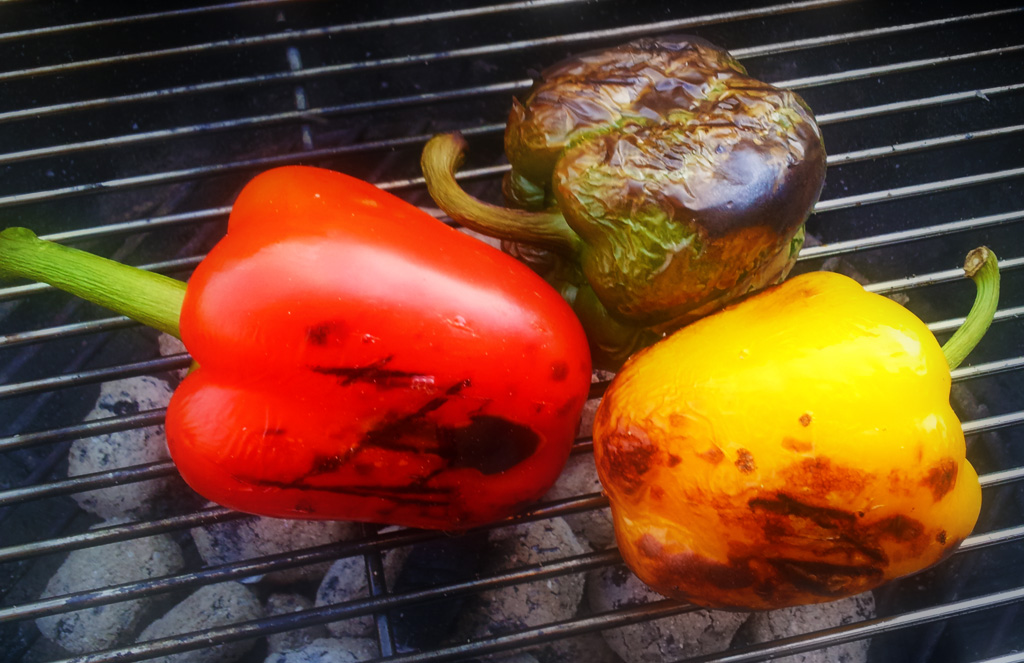
- Put them on the grill, skin side down, and let them roast until the skin is black and starts peeling. Burning the (pepper’s) flesh a little is not a bad thing
- When they’re done roasting, put them all in a bowl that you cover with some clingfilm. Let them rest for 30 minutes. This will make the skin loosen much easier due to the moisture being trapped in, and as an added bonus they will be cooler so you don’t burn your fingers in the next step
- One rested, use your fingers to peel off all (or most of) the skin
- Cut the pepper pieces into thin strips lengthwise, chuck them in a bowl, drizzle with some lemon juice, olive oil, salt and pepper to taste